











Wofür werden Hartmetallfräser verwendet?

Jan.
What Are Carbide Burs and What Are They Used For?
Find out what carbide burs are used for! They are the perfect allies for working on hard materials and for fixing many small “processing mishaps.” Think of when you need to finish a small weld or precisely shape a dental composite.
These rotary dental instruments are essential for cavity preparation and composite shaping. But their usefulness goes far beyond that.
Read on to discover all the tips and tricks and how to choose the right instrument. Proper bur maintenance and impeccable instrument sterilization are the foundation of safety in dentistry.
What Are Carbide Burs?
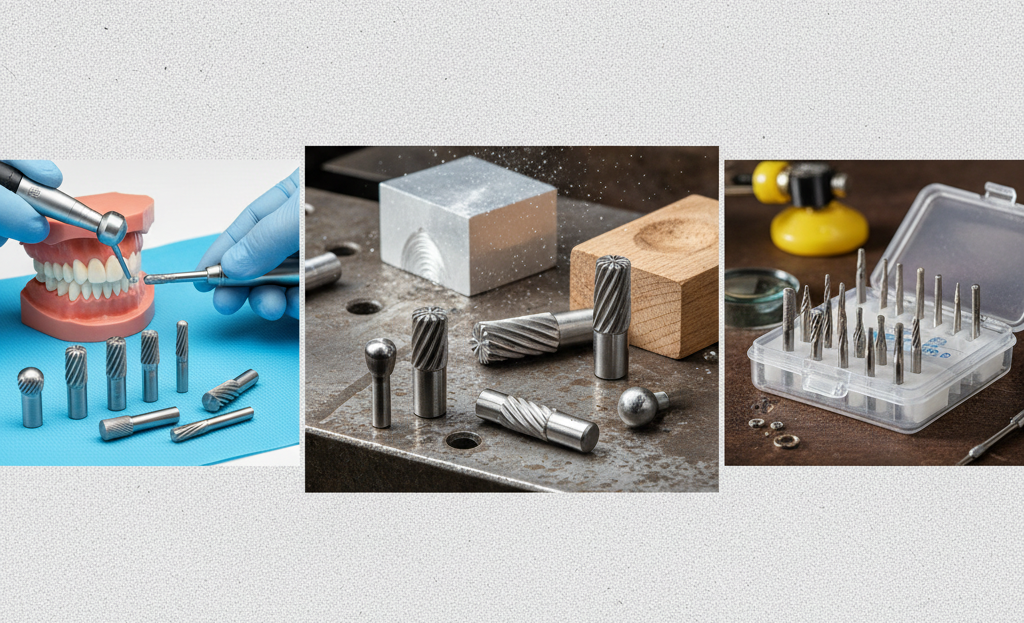
Hartmetallfräser are rotary tools that are mounted on dental drills or CNC machines. They consist of a shank, which secures the tool, and a working head with a specific shape.
The real difference lies in the materials used for the burs. Their active head is not made of ordinary steel, but of something much more durable.
Tungsten Carbide: Features and Advantages
The head is made of tungsten carbide, an extremely hard composite material. It is produced by fusing tungsten and carbon powders together.
This process gives it a hardness superior to high-speed steel. The advantages? An extremely long carbide bur lifespan, the ability to maintain a sharp cutting edge over time, and excellent resistance to heat generated by friction.
The result is outstanding performance even on the most difficult materials.
What Are Carbide Burs Used For? Main Applications
The practical answer to what carbide burs are used for covers a wide range of applications. Their main purpose is to remove material in a precise and controlled manner.
They are used for shaping, finishing, carving, and smoothing all kinds of surfaces. Imagine creating a recess for a hinge in wood or refining the edge of a dental crown.
Working on Different Materials
Choosing the right bur depends entirely on the material being processed. Geometry and cutting type are designed to optimize results while preventing tool damage.
Metals (Steel, Aluminum, Cast Iron)
In workshops, they are essential for roughing and finishing castings, welds, and components. They are used to remove burrs from parts and prepare surfaces for subsequent machining.
They are ideal for machining tough materials such as alloy steels and cast iron.
Wood, Plastic, and Composite Materials
On wood and plastic, they allow precise carving, grooves, and complex shapes. Perfect for refining a joint or creating decorative elements.
They also perform very well on modern composite materials, such as carbon fiber.
Ceramics, Stone, and Hard Materials
For very abrasive materials, diamond burs vs carbide are often used. However, carbide burs are useful for precision work on technical ceramics or softer stones. Their toughness makes them a valid choice in specific cases.
Specific Functions in Machining
Beyond the material, the specific function they must perform during the job is also important.
Deburring, Finishing, and Polishing
One of the most common uses is removing burrs left by previous cutting or milling operations. Then, with finer cutting edges, the process moves on to finishing and polishing.
This results in a smooth and uniform surface—a crucial step both in precision mechanics and at your dentist’s office.
Shaping, Carving, and Sculpting
Thanks to their many shapes, they are perfect tools for restorative dentistry. They are used for dental composite shaping, wood carving, or sculpting small objects.
They allow the creation of concave shapes, grooves, and textures with millimetric detail. Craftspeople and dental technicians could not do without them.
Dental and Medical Applications
This is one of the most specialized fields. Hartmetallfräser are essential dental Instrumente.
They are mounted on dental drills für cavity preparation during a dental filling, for removal of old restorative material, or for amalgam shaping.
They are also used for fissure cleaning, in oral surgery, and for dental prosthetics. Choosing between composite burs or burs for other materials is part of a dentist’s daily routine.
Types of Carbide Burs
There are many types of burs. They are mainly classified by geometric shape and cutting type. Understanding the classification of burs helps you choose the right tool on the first try.
Common Shapes and Cuts
The shape of the head determines what kind of work you can do. Each geometry has a specific purpose.
Round, Cylindrical, Conical, and Flame-Shaped Burs
Round (ball) burs create concave cavities or round off edges. Cylindrical burs with flat ends create holes or flat surfaces.
Conical burs are among the most commonly used in dentistry for enamel preparation. Flame-shaped burs, with their tapered design, are excellent for shaping and final contouring.
Types of Cuts (Single, Double, Special)
The cut can be single (one spiral blade) or double (two crossed blades), the latter being more efficient and faster. There are also special cuts, such as multi-blade or cross-cut designs.
They are designed for ultra-smooth finishing and polishing or for specific materials. The choice affects working speed and the final surface roughness.
Häufig gestellte Fragen
What are carbide burs?
They are rotary tools with a tungsten carbide head, an extremely hard material. They are mounted on dental drills or machines to remove material with precision. They are known for their long lifespan and heat resistance.
Which materials are carbide burs suitable for?
They are excellent for working hard materials such as metals (steel, aluminum), wood, plastic, and composites. They are also used on technical ceramics or softer stones, thanks to their toughness and ability to retain a sharp cutting edge.
What are the main uses in dentistry?
In dentistry, they are essential for dental cavity preparation, removal of old fillings, and composite shaping. They are also used in oral surgery and for manufacturing dental prosthetics.
What functions do they perform in industrial or craft applications?
They are mainly used for deburring, finishing, and polishing metal or wooden parts. They are also ideal for shaping, carving, and sculpting operations, allowing the creation of detailed shapes and grooves.
How do you choose the right carbide burs?
The choice depends on the material being processed and the specific function. Factors include head shape (e.g., round, conical) and cutting type (single or double). In dentistry, for example, conical burs are commonly used for enamel preparation.